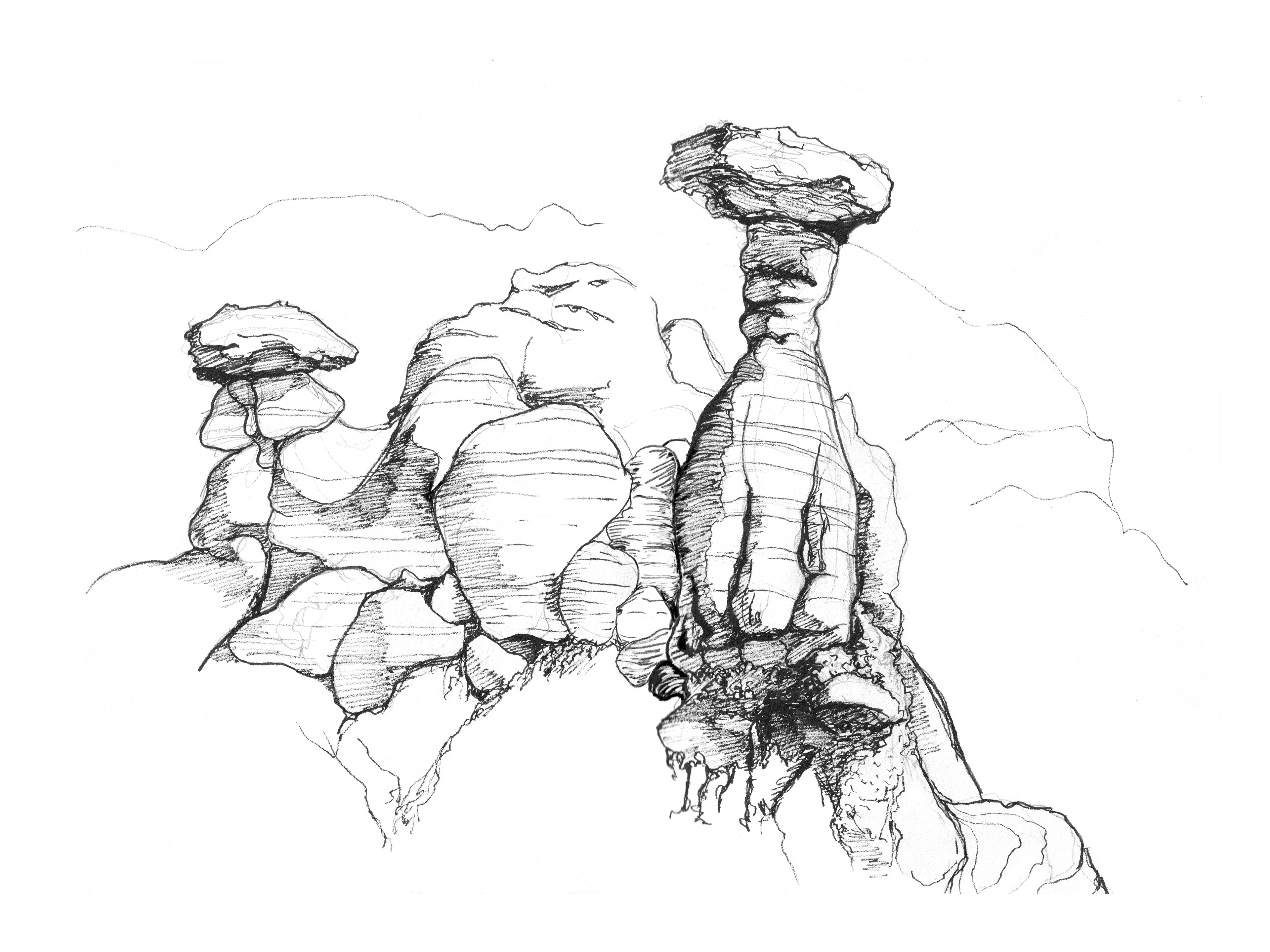
Toadstool Hoodoos, Kanab, UT
Balanced on slender columns of Entrada Sandstone, the Kanab Toadstool Hoodoos rise improbably from the desert floor. These formations appear where a hard caprock protects the softer layer beneath it. Over time, wind and water erode away the weaker stone, leaving a narrow pedestal topped with a resistant block.
Plein Air, Pen and Ink
Click on image to purchase
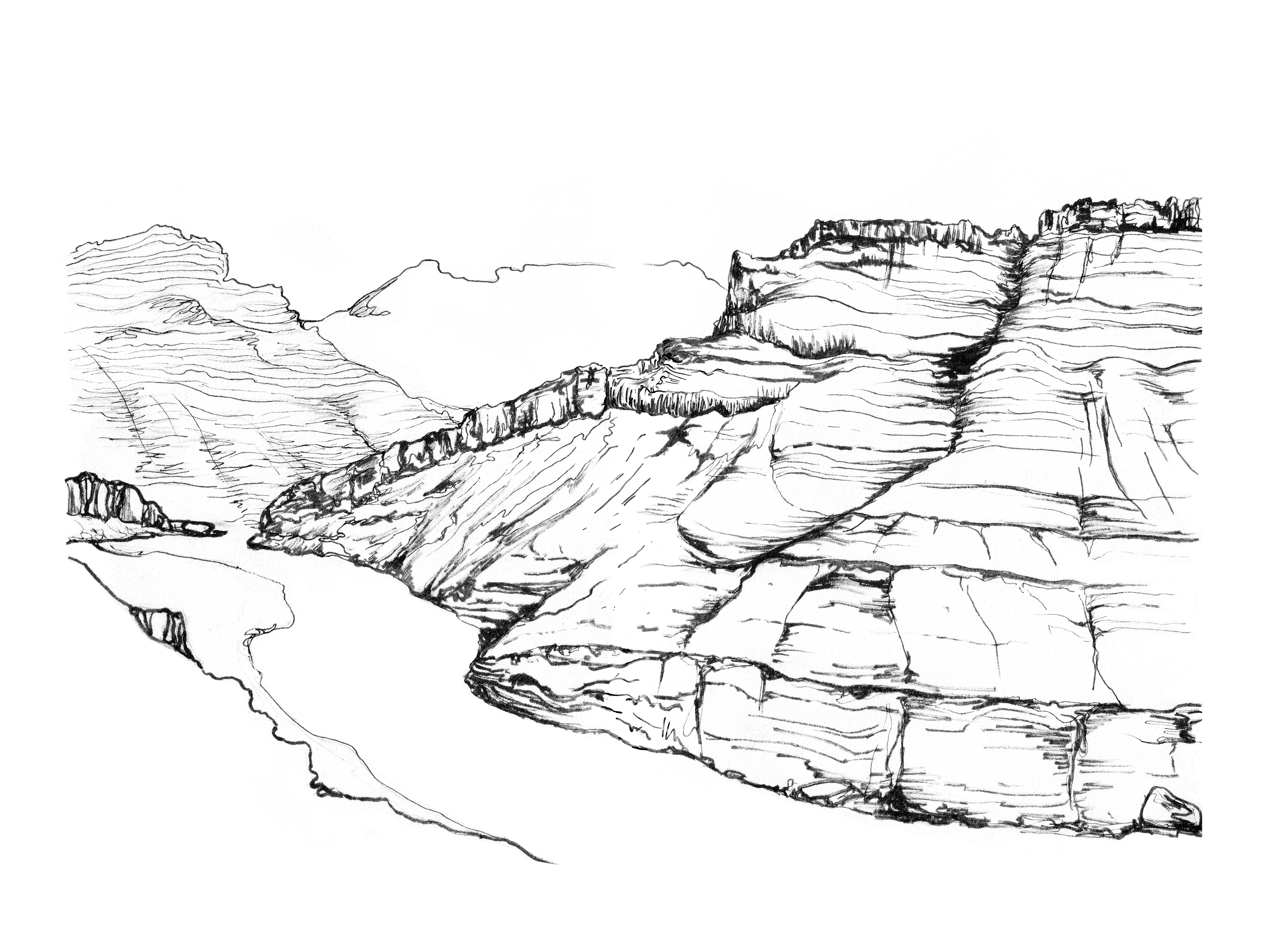
Lee's Ferry, Grand Canyon, AZ
Along Marble Canyon, sheer walls of Navajo Sandstone form an unbroken barrier of cliffs. But here, faulting along the Echo Cliffs monocline lifts and tilts the rock layers, exposing softer Kayenta and Moenave formations at river level. Those weaker strata erode faster, creating a rare low-angle break in the canyon’s architecture.
That subtle structural weakness made this spot a natural crossing point. Ancestral Puebloan communities grew crops and stored food in nearby side canyons, and later Southern Paiute and Navajo people used the area as a seasonal travel corridor where the cliffs finally eased.
Today, this geologic gateway still marks the transition from Glen Canyon into the depths of Marble Canyon and the start of Grand Canyon river journeys.
I drew this scene while visiting Lee's Ferry with my students on an outdoor semester course. Together we also investigated the water chemistry of the river and learned about water usage and rights in the Colorado River Compact.
Plein air, Pen and Ink
Click on image to purchase
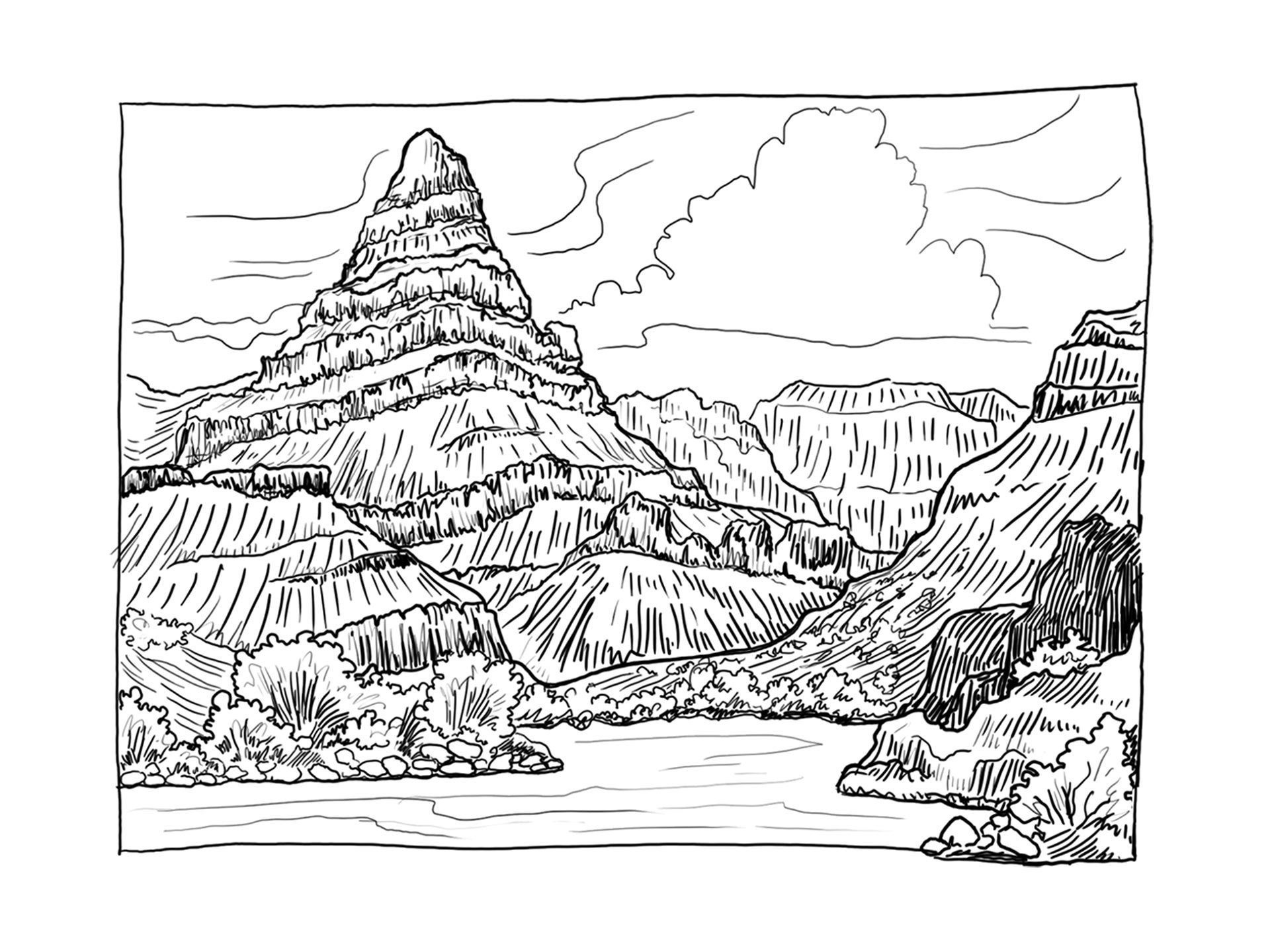
Diamond Peak, Grand Canyon NP, AZ
Despite the angled September sun casting deep shadows along the steep canyon walls, a warm breeze was already picking up, funneling down the canyon. Diamond Peak, a sharp pyramidal geologic anomaly against the flat-terraced walls of most of the Grand Canyon, stood sentinel over us as we packed our rafts for the last time.
This USGS botanical monitoring trip came on the heels of some big, challenging, life changes. But getting to do what I do best—botany, art, outdoor recreation—became a salve. We were studying dam-altered flood regimes and how riverside plant communities colonize in the new normal.
This is one of the few places along the river where geology collapses deep time: relatively young basaltic lava flows (less than a million years old) meet the 1.8-billion-year-old Vishnu Schist, some of the canyon's oldest basement rock, in a single view.
I'd forgotten my usual sketchbook and calligraphy pen in my car 280 river miles upstream, so I borrowed a sketchbook from a fellow scientist and sketched with a mechanical pencil. Different tools, same need to capture a moment before we left.
Plein air, mechanical pencil and digital rendering
Click on image to purchase
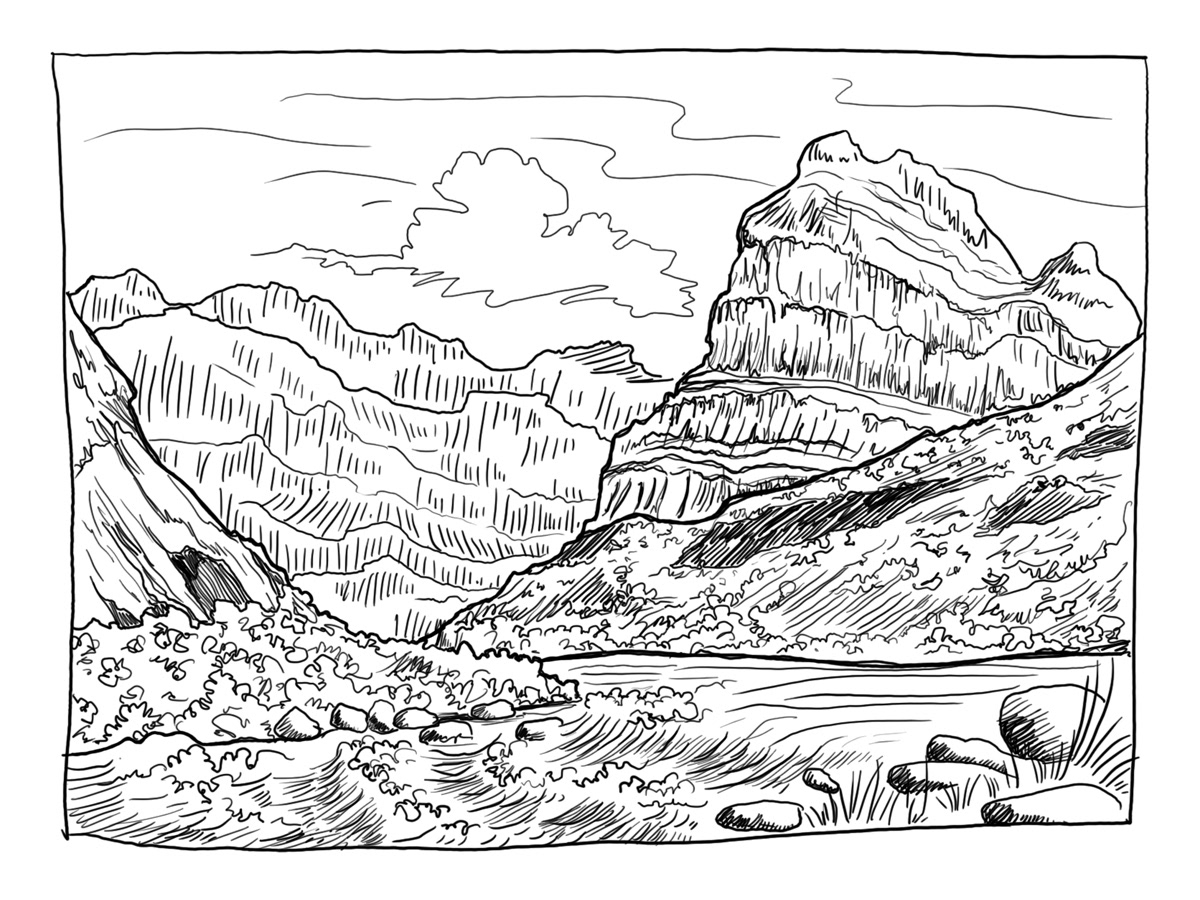
205 Camp and Rapid, Grand Canyon NP, AZ
Light descended slowly down the canyon walls as I drew this scene before breakfast, casting everything in orange. The layered sedimentary formations, the river's surface, even the rapid's white water took on a warm glow. This ship-like rock formation rose behind mile 205 rapid, its prow cutting through geologic time.
We were eight days into a USGS botanical monitoring trip, studying how dam-altered flood regimes shape riverside plant communities. By this point, river rhythm had settled in—wake, move downstream, monitor, document, repeat.
The rapid's roar had been our constant companion through the night. Side canyons funneled hot air down from the upslope ovens of sun-baked soils directly onto camp, turning sleep into a negotiation. I draped a wet flannel over myself and lay outside under the stars, the rapid's cool mist a small mercy against September heat. Beside me, sacred Datura flowers had unfurled in slow motion after the sun slid behind the canyon walls. I stayed up watching, casting the scene in red with my headlamp light, as sphinx moths appeared to drink the flower's nectar, a welcome distraction from the heat.
I'd forgotten my usual sketchbook and calligraphy pen in my car 280 river miles upstream, so I borrowed tools from a fellow scientist. This was drawn with a mechanical pencil on borrowed paper, an attempt to hold onto a moment before the river carried us on.
Plein air, mechanical pencil and digital rendering
Click on image to purchase
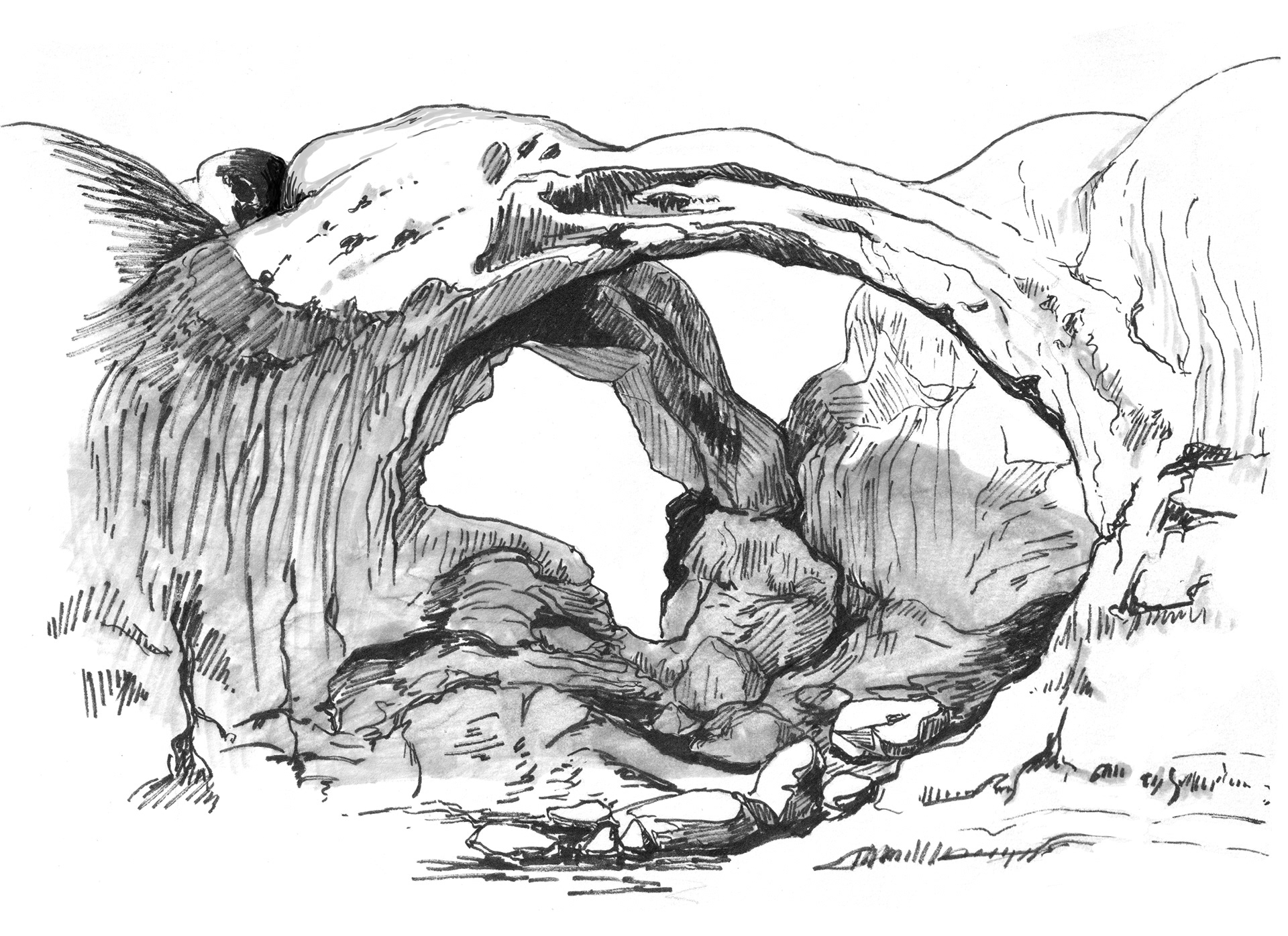
Like most of the arches in Arches NP, Double Arch is formed from the Jurassic sand dunes of Entrada Sandstone. What makes Double Arch unusual is how it formed: instead of eroding from a vertical fin like most arches in the park, it was carved from the inside out.
Water pooled in a natural bowl at the base of the cliff, exploiting fractures and softer sedimentary layers. Over thousands of freeze–thaw cycles, the rock above was hollowed upward while adjacent joints widened, eventually leaving two intersecting arches that share a massive central pillar.
The result is a rare “amphitheater-style” arch—one shaped not just by wind, but by water, chemistry, and structural weaknesses written into the rock since the Jurassic.
Plein air, pen and ink, alcohol marker
Click on image to purchase
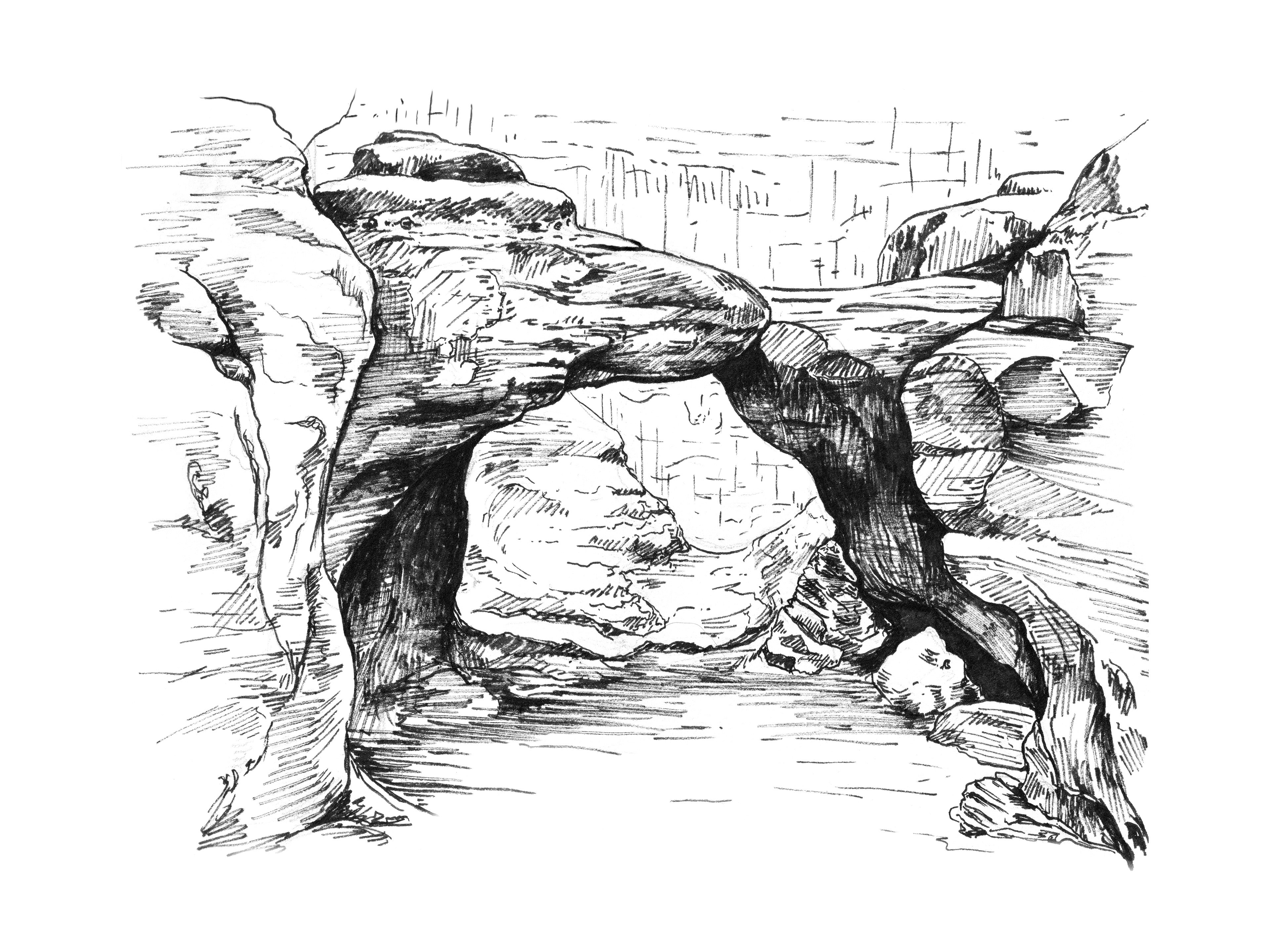
Sand Dune Arch, Arches National Park, UT
Entrada Sandstone was formed in the Jurassic period around 160 million years ago from massive desert sand dunes. As this formation has been uplifted over time, wind and water has infiltrated fissures in the rock, forming long fins of sandstone. Differential weathering has allowed some of these fins to turn into beautiful arches such as this one!
Plein Air, Pen and Ink
Click on image to purchase
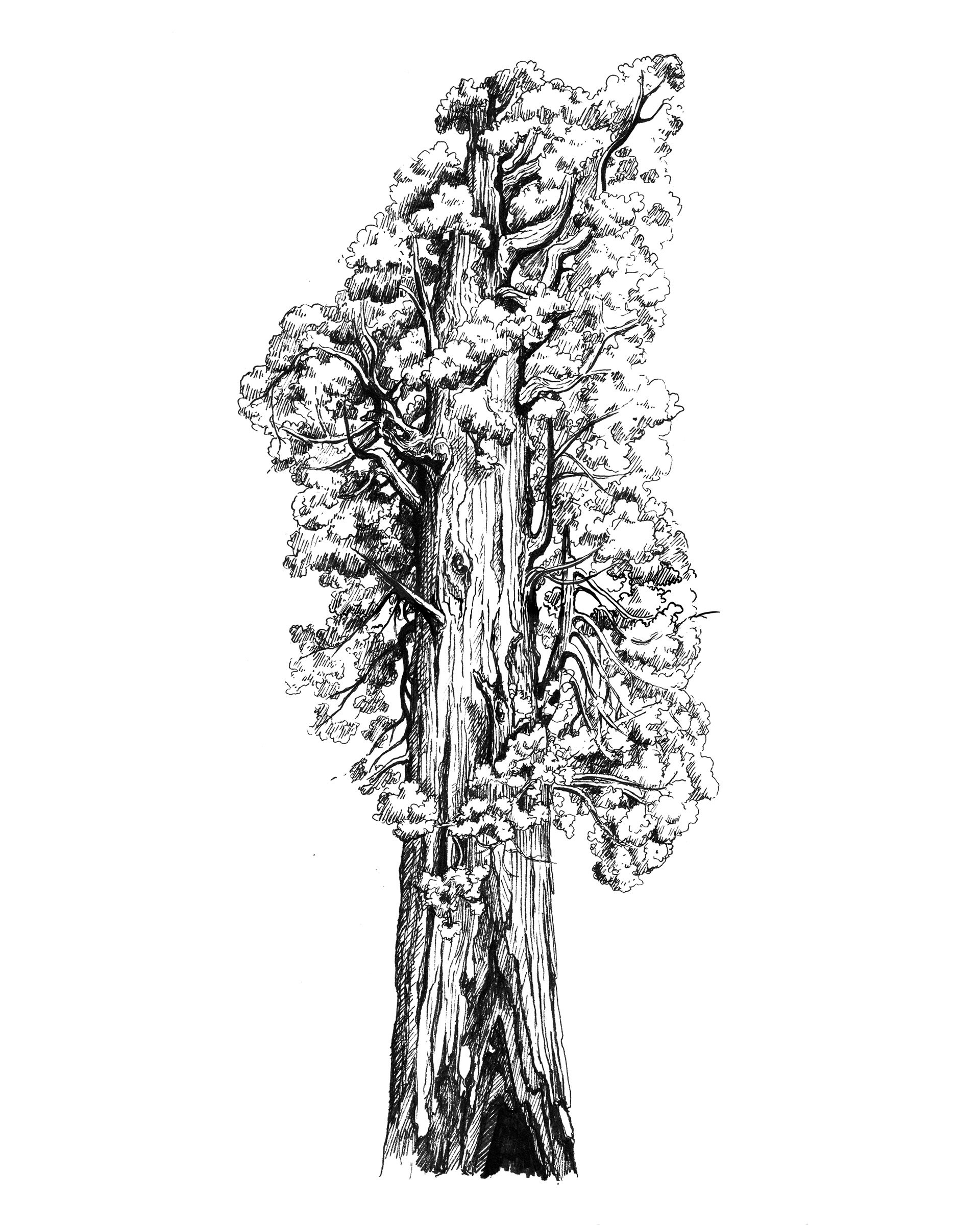
Mountain Home Demonstration State Forest, CA
Giant sequoias (Seqouiadendron gigantum) were previously thought to be resilient to native bark beetle attack until drought and fire stress changed the equation. The beetles attacking them typically feed on fallen branches, not living trees. But in recent years, dozens of mature sequoias weakened by fire and drought have died with beetle involvement, a phenomenon we're only beginning to understand.
This year, my background in canopy ecology allowed me the opportunity to volunteer on a study by Ancient Forest Society and CSU monitoring 90 trees’ response to beetle attacks across the Sierra Nevada. The research examines where sequoia bark beetles overwinter, how beetle attack affects tree carbon and water status, and how tree physiology and defensive traits influence beetle behavior and survival.
Between collecting branch samples and recording data, I spent some time drawing this tree named Euclid. This tree was quite charismatic, with a huge fire scar at its base and buttressed branches in its crown. There's something profound about capturing the architecture of a 3,000-year-old survivor while measuring the physiological signs of its stress.
I found translating the massive scale of this tree to paper to be nearly impossible, but it was an enjoyable challenge. These trees are so special, and I am so thankful for organizations like Ancient Forest Society who are working on protecting them.
Pen and ink, plein air
Click on image to purchase
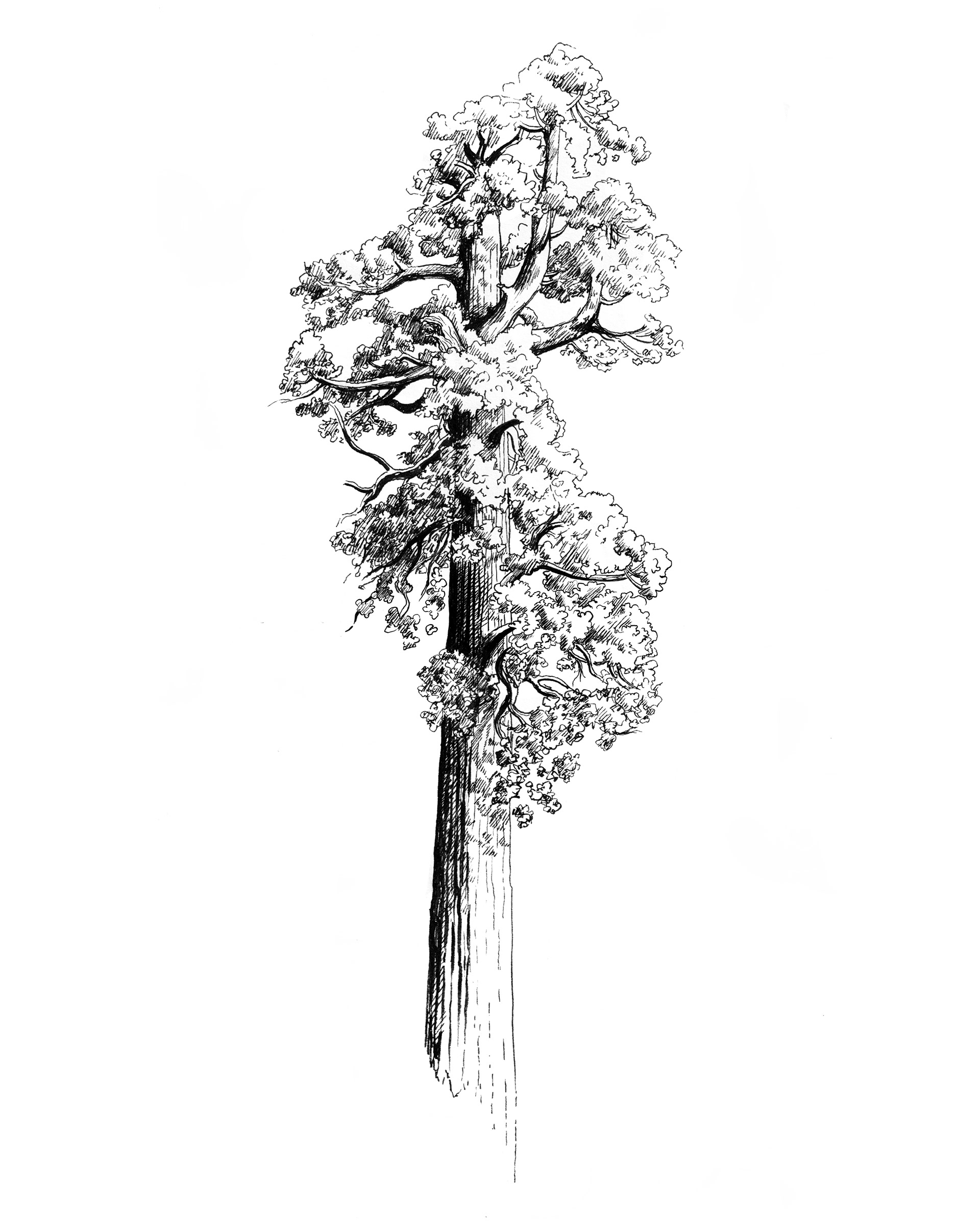
Mountain Home Demonstration State Forest, CA
Giant sequoias (Sequoiadendron giganteum) are the most massive trees on Earth by volume. Individual trees can exceed 1,000 metric tons, accumulating biomass at a scale unmatched by any other living organism.
Many of the trees alive today established more than 2,000 years ago. Their thick bark and annual growth rings record centuries of fire, drought, and climatic variability, making each individual both a biological structure and a living archive of environmental history.
This tree loomed over our campsite, welcoming us home after each field day with Ancient Forest Society while I volunteered for their Bark Beetle Project.
While working long days in the field, it can be easy to start thinking of the target organism or ecosystem as an accumulation of data. Drawing gives me a chance to pause, notice the details, and connect with these trees in a different way. Sequoias are truly the most incredible trees, and I am so lucky to have gotten to work with them.
Pen and Ink, Plein Air
Click on image to purchase
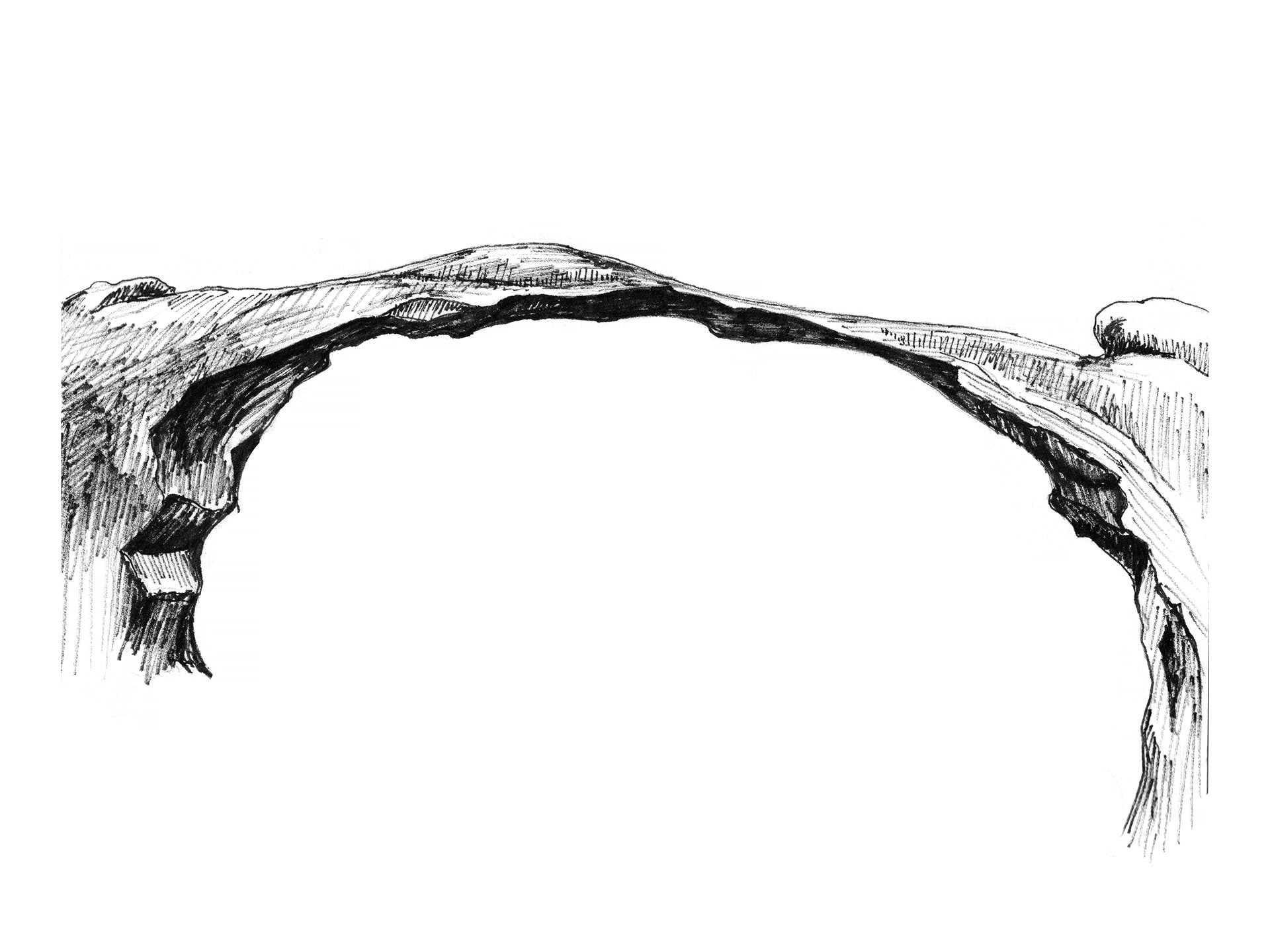
Landscape Arch, Arches NP, UT
Formed by the relentless erosion of wind and water on either side of an Entrada Sandstone fin, this 290 ft long arch is still changing. In 1991, a 60 ft slab fell from the underside. Now, at its narrowest point, the span is only 6 feet thick. Engineers estimate it defies the normal limits of what sandstone can support.
When I arrived at Landscape Arch, the sun was already setting. I gave myself 15 minutes to draw before rushing back to the trailhead. Drawing beneath this arch meant working in the presence of deep time, trying to capture something ancient that's also ephemeral. One day, this arch will fall, but for now we get to witness this fleeting moment in geologic time when stone still bridges sky, a reminder of our own fleeting time on this land.
Plein air, Pen and Ink
Click on image to purchase
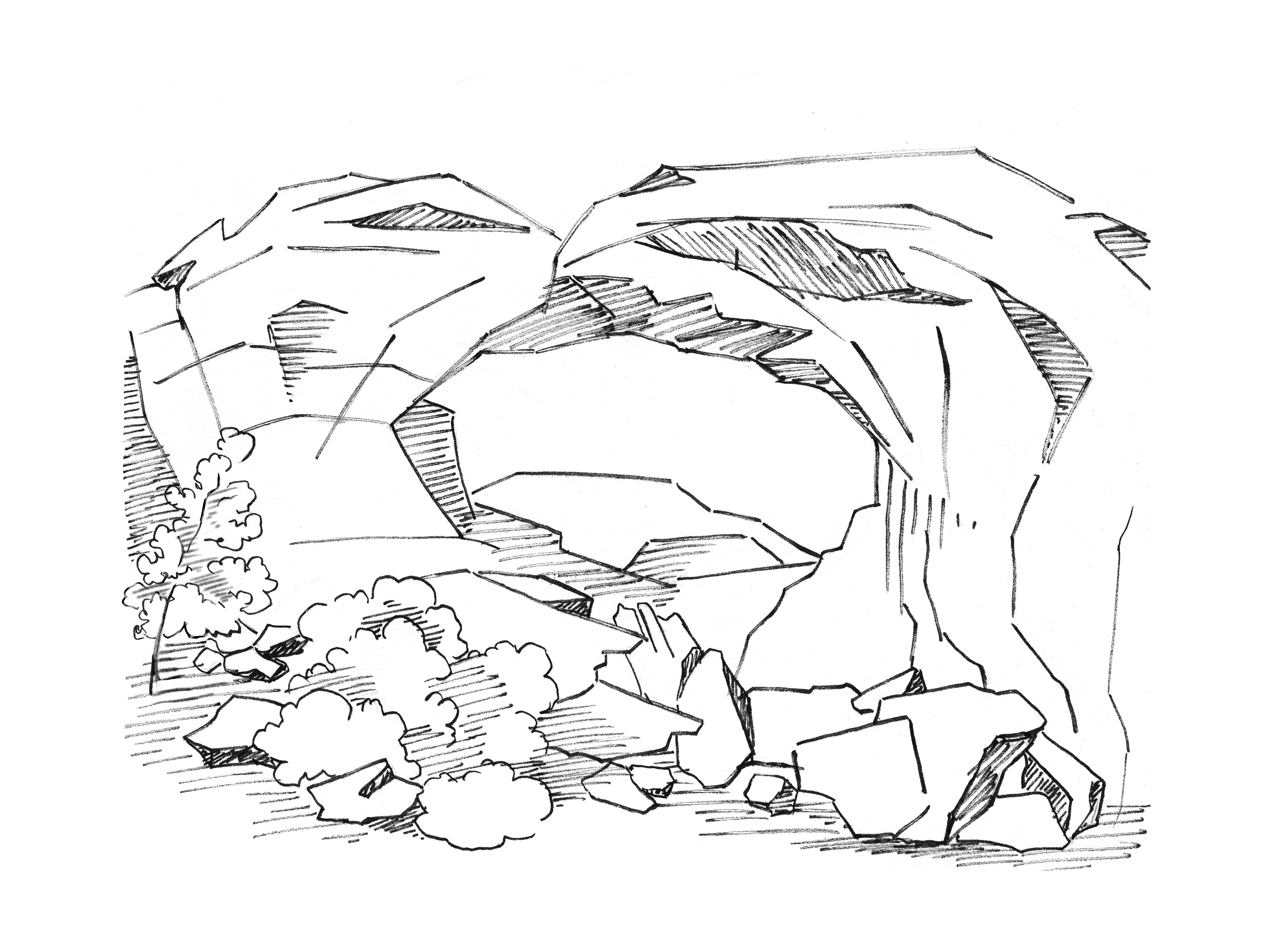
Broken Arch, Arches NP, UT
Click on image to request print
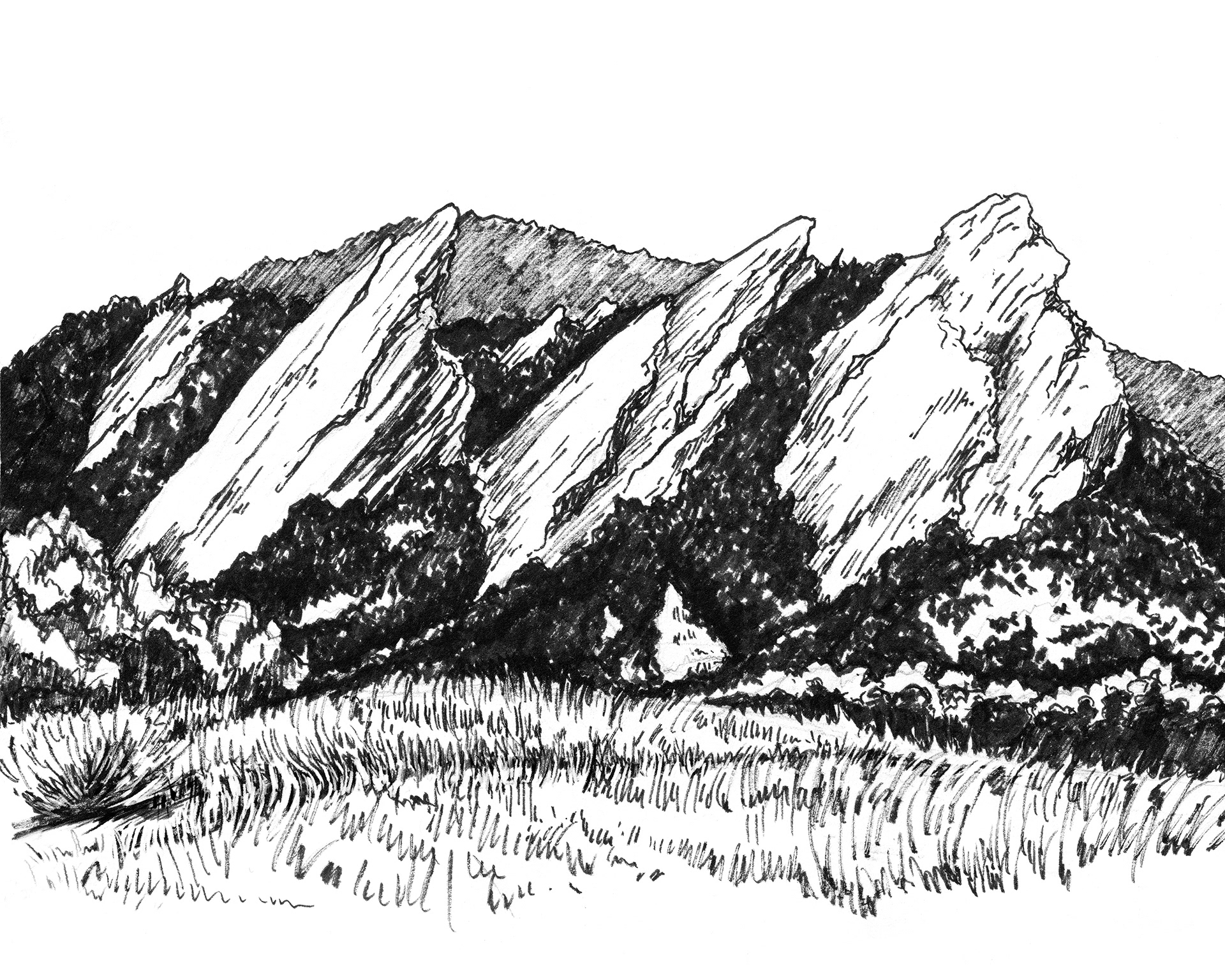
Flatirons, Boulder, CO
The Fountain Formation, of which the iconic Boulder Flatirons are formed, are a conglomerate sandstone deposited at the delta of a river outlet that carried sediment of all sizes from the top of the ancestral Rockies to the shores of an ancient inland sea. The same formation forms other iconic features like Red Rock Amphitheater and Garden of the Gods. Long after the sediment was deposited, a continental collision uplifted the layers of rock. This deposit is harder than the surrounding layers and erodes more slowly, allowing for the sharp relief of these features.
Plein Air, Pen and Ink
Click on image to purchase
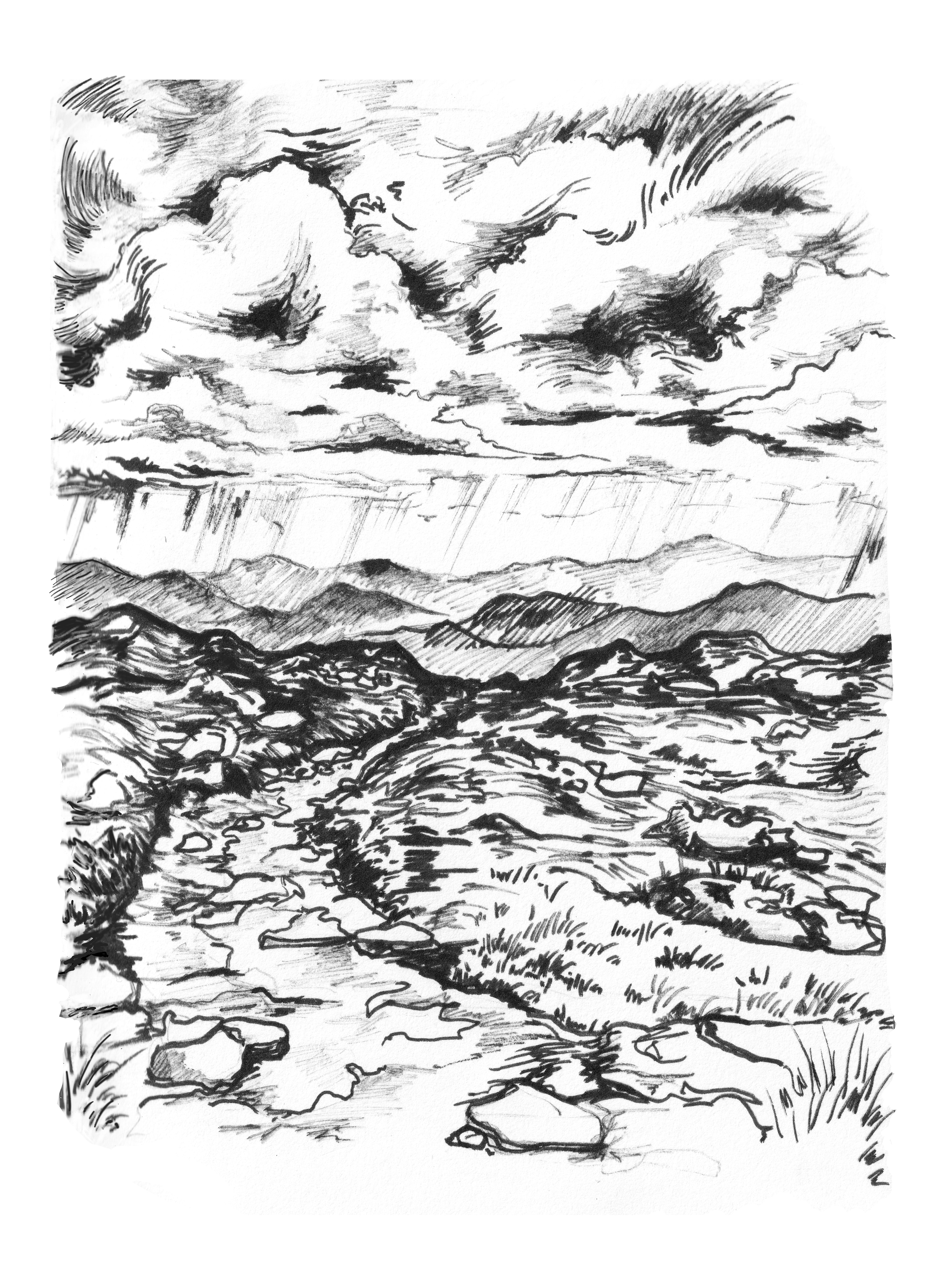
Mount Mansfield, Green Mountains, VT
Click on image to request print
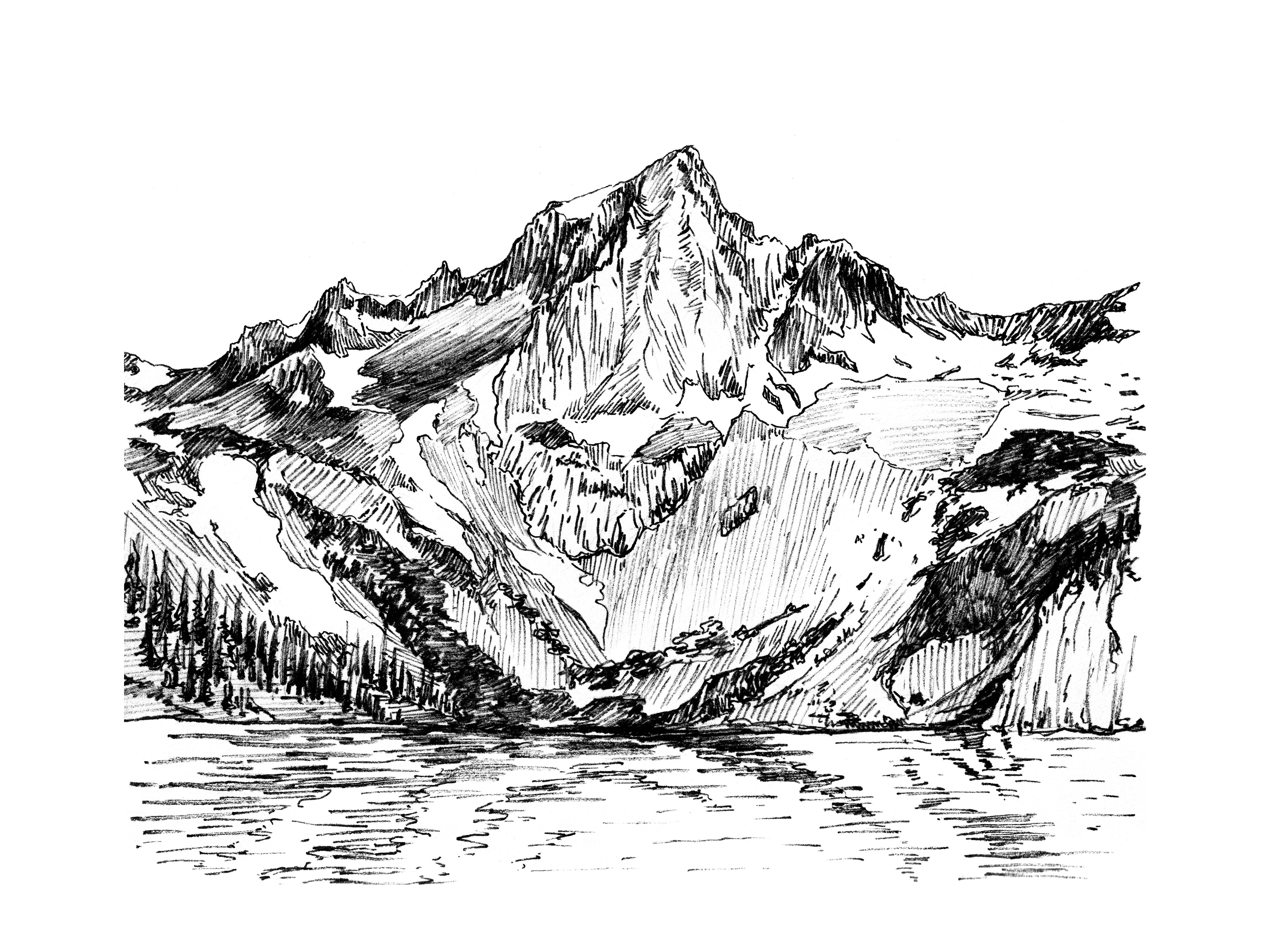
Snowmass Lake, Maroon Bells Wilderness, CO
Snowmass Mountain rises from the rugged Elk Range. While many of the iconic red summits are built from the Maroon Formation, soft, reddish mudstones laid down 300 million years ago in coastal floodplains, Snowmass stands apart. Its slopes are carved from hard Precambrian metamorphic rock formed nearly 1.7 billion years ago. Glaciers of the last Ice Age cut into this ancient stone, sculpting the sharp ridges and craggy basin walls we see today.
But those glaciers aren’t the “snowmass” that gives the mountain its name. Draped across the east face is a perennial snowfield, snow that lingers year-round thanks to high elevation, shade, and deep winter storms. Although it endures through summer, it never accumulates or flows enough to become a true glacier.
Plein Air, Pen and Ink
Click on photo to purchase

Snake River Overlook, Grand Teton National Park, WY
Despite the many flaws in the fortress conservation model, I firmly believe our nation's national parks and other protected lands are one of its best treasures. I grew up with Ansel Adams prints on the walls of my house. Adams's print of the Tetons and the snake river from this very spot helped secure the ultimate protection and expansion of Grand Teton National park. I can only hope that my art can inspire the same sort of awe and care in the people who encounter it.
The view has changed as the trees keep growing, but it's still an inspirational view.
Plein air, pen and ink.
Click on photo to purchase.

View from Taggart Lake, Grand Teton National Park, WY
Sometimes, drawing in the mountains feels like an exercise in object permanence. Mountains are known for creating their own weather, but how do they do it? When warm, humid air travelling across a landscape encounters a mountain, the air is forced upward, where the temperature cools dramatically. Cooler air can hold significantly less moisture than warmer air, so where this uplift happens, rain falls.
The mountains were playing a game of hide-and-seek the entire time I drew them. I stitched together tiny vignettes as they revealed themselves, capturing the full landscape just before the clouds obscured the entire scene again.
Plein Air, Pen and Ink
Click on photo to purchase.

Grand Teton National Park, WY
The Tetons create an amazing optical illusion of an immense flat tableau draped before you when you sit in the valley. This is due to the unique geologic history that formed the peaks.
At the foot of the mountains is a 44-mile-long fault, created at a stress point in the earth's crust from the subduction of the Pacific plate under the continental plate, a tectonic collision that formed the Rocky Mountains 70 million years ago.
Here, though, the mountain building happened much more rapidly, only 10 million years ago. When the north-south fault developed, the western edge of the plate hinged upward as the eastern edge hinged downward. The result is a mountain range that seems to rise from nowhere, mountains without foothills.
The stark 7,000+ ft relief of the range only hints at the full displacement of the stratigraphic layers. The same rock we see at the peak of the Grand Teton can be found 30,000 feet beneath the surface to the east of the fault line.
The illusion of flatness breaks only once you hike into the mountains, when the layers of granite, gneiss, and limestone from ancient sea floors unfold around you. This week, I got to hike the Teton Crest Trail again. I last hiked it 11 years ago with a group of students, and it has been my favorite hike ever since. I was glad to be reminded that it sits at the top of my list for a reason! What a beautiful, immense, landscape. It has my whole heart
Plein Air, Pen and Ink
Click on photo to purchase.